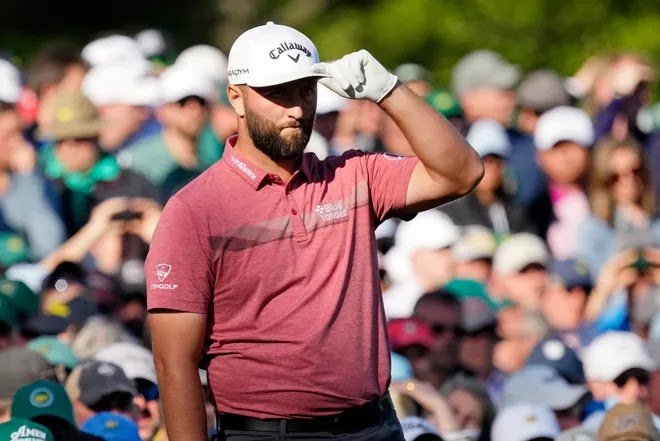
Jon Rahm played a 3-under 69 in the final round to end the event at 12-under par and win the green jacket. He had been two strokes behind Brooks Koepka going into the final day. Rahm’s first major championship victory came in the 2021 U.S. Open, and this is his second major championship triumph overall.
He joined Seve Ballesteros as the only other Spanish player to have won two different majors.
The 87th Masters got underway on Sunday in sunny, dry, but cool conditions after two days of terrible weather. Golfers finished the third round in the morning before beginning the fourth and final round in the afternoon.
Golfers experienced 45 minutes of rain, which washed out the remainder of the third round, and the Masters paused play on Saturday.
Live Leaderboard: Up-to-date scores, schedules, pairings, and more from the Masters Tournament
In the morning, Koepka, who switched from the PGA Tour to the LIV tour supported by Saudi Arabia, was in the lead at 13 under par. But, he finished his third round with two bogeys and dropped to 11 under, two shots ahead of Rahm. Nevertheless, Koepka’s erratic play on the front nine gave Rahm the opportunity to pass him in the standings.
Due to an injury, Tiger Woods, who was in last place, withdrew before Sunday’s play began.
Mickelson interrupts a reporter’s LIV Golf question after shooting 65.
When the three-time champion scored a 7-under 65 to finish the event at 8-under, Phil Mickelson established himself as one of the best tales of the Masters. The best final-round performance by a player 50 years of age or older in tournament history was his Sunday comeback.
But, during a post-tournament news conference at Augusta National, attention was still mostly directed toward his affiliations.
A sizeable portion of Mickelson’s following was turned off by his choice to leave the PGA Tour for the LIV Golf tour, which is sponsored by Saudi Arabia. When asked if he thought his Masters performance had brought some of those fans back, Mickelson didn’t appear interested in responding. In actuality, Mickelson interrupted the reporter before the query was fully answered.
There are distinct problems “explained Mickelson. “How golf and the industry surrounding professional golf have been handled during the course of my career. two completely different things.
Three of the 18 players LIV Golf sent to the Masters finished in the top three. At 8-under, Mickelson and Brooks Koepka tied for second place, while Patrick Reed was one stroke back at 7-under.
Golfers Seve Ballesteros and Jose Maria Olazabal, who are inspired by Spanish history, and Jon Rahm
Jon Rahm acknowledges that if it weren’t for the long tradition of Spanish golfers, particularly Seve Ballesteros, who passed away in 2011, he might not be playing the game today.
The green jacket was won by Rahm on Sunday, the 40th anniversary of Ballesteros’ second Masters victory in 1983. With his victory, Rahm joined Ballesteros as the only players from Spain to have won two different majors. Ballesteros would have turned 66 on Sunday as well.
Rahm stated to Jim Nantz on the CBS broadcast that “the history of the game is a significant part of why I play.” “One of them is Seve. It’s tremendously special for me to complete it on the 40th anniversary of his victory, which also happens to be his birthday on Easter Sunday. If it weren’t for that 1997 Ryder Cup victory, I’m not sure where I’d be.”
Jose Maria Olazabal, who won the Masters while playing for Spain in 1994 and 1999, welcomed Rahm on the 18th green on Sunday.
Jon Rahm receives a green jacket and celebrates with his wife and children.
Just seconds after winning the Masters, Jon Rahm celebrated with his wife, Kelley, and two young sons after making his par putt on the 18th hole.
Scottie Scheffler, the champion for the year 2022, presented Rahm with his green jacket as they made their way back to the clubhouse.
Although Phil Mickelson and Jordan Spieth’s late charges in the final round on Sunday didn’t change the tide in his favor, Rahm claimed they did ignite a fire beneath him.
Rahm said on the CBS broadcast that “Phil and Jordan were scoring birdies and finished well.” They completed the round as we completed the tenth. Thus it was important to watch that I didn’t place myself in challenging sports.
Although there wasn’t really a single turning point, I believe that hitting the draw on 13 was the beginning.
“I was basically ordinary,” said Brooks Koepka.
After placing in a tie for second place at the Masters, trailing victor Jon Rahm, Brooks Koepka claimed that his performance “was pretty mediocre today.”
Beginning the final round with a two-stroke advantage, Koepka struggled over the front nine on Sunday, which gave Rahm the opportunity to catch up to him.
After the final round, Koepka commented on the CBS broadcast, “I didn’t receive any favorable breaks.” “I made some solid shots on the par threes, but they ended up in poor locations, which is occasionally the case. Nonetheless, I don’t think I played all that poorly and knew I wasn’t good enough. Best wishes to Jon.”
Koepka tied three-time Masters champion Phil Mickelson for the lead with an 8-under total for the competition. Koepka and Mickelson both quit the PGA Tour for the LIV Golf tour, which is sponsored by Saudi Arabia.
At an 8-under total for the tournament, Koepka is tied for first place with three-time Masters champion Phil Mickelson. Koepka and Mickelson both left the PGA Tour for the Saudi Arabia-sponsored LIV Golf tour.
Rahm finished the competition with a 12-under total, winning his second major championship of his career. The 2021 U.S. Open was also won by the Arizona State product.
Before losing steam at the conclusion of the third round, Koepka’s score had dropped to as low as 13-under. But, in the final round on Sunday, he struggled on the front nine to end the tournament at 8-under. Rahm took advantage of the opportunity to win the green jacket at Augusta National, where he had been constantly at the top of the leaderboard all week.
Koepka makes a birdie at hole 16 to give Rahm a three-hole lead.
With two holes left, Brooks Koepka holed a crucial birdie putt on the par-3 16th to go into sole possession of second place at 9-under. After making par at hole no. 16, Jon Rahm had a three-stroke advantage.
Earlier in the day, Koepka had a two-stroke advantage over Rahm; however, Koepka struggled on the front nine, which let Rahm seize the initiative. After his birdie on hole No. 16, Koepka did pass Mickelson (-8) in the standings.
Sam Bennett, an amateur, finished the competition at 2-under par, the lowest score this week for an amateur. He was 8-under after the second round of play on Friday and played in the last group on Saturday.
Rahm extends the advantage on No. 14 and displays dominance
With four holes left, Jon Rahm increased his advantage to four strokes with a birdie on hole 14. Rahm’s birdie on the par-4 hole was just the seventh of the day.
Rahm (-12) produced a fantastic second shot from the right side of the fairway that veered along a ridge and put him in a great position to sink a calm birdie putt.
In contrast, Brooks Koepka made a bogey after three-putting hole number 14. After 14 holes, he is 7-under par. When the third round of play resumed on Friday, Koepka was 13-under.
With a round of 65 on Friday, Phil Mickelson is alone in second position and 8 under par.
Rahm maintains composure while Koepka messes up No. 12.
When he teed off on the par-3 No. 12 at Augusta National, Brooks Koepka’s inconsistent play in the championship round continued to fly well left of the landing target on the green past Rae’s Creek. He then made an attempt to chip onto the putting green, but he missed it short on the perimeter. Then he missed a two-putt to go to seven under par. More significantly, Koepka’s bogey pushed him into a tie for third place with Mickelson, who now holds sole ownership of second place at 8-under after Phil Mickelson’s bold climb up the leaderboard earlier in the afternoon.
Nonetheless, Jon Rahm continued his flawless round by making his tee shot on the green at hole number 12. Then, with a confident putt, he brought his attempt at a par within striking distance. At 10-under par, he maintained his two-stroke lead.
Rahm and Koepka each miss a shot, and Mickelson surges to the top of the leaderboard.
Brooks Koepka isn’t just attempting to halt the bleeding; he’s still looking for his first birdie since the eighth hole in the third round. After having to three-putt at hole No. 9, Kopeka made his third bogey of the front nine, dropping him to 8-under par and into a tie for second.
As Jon Rahm made his first error of the day at hole No. 9 by misreading the speed of his par putt, things could have been worse for Koepka. As the last pair turns, Rahm still leads by two strokes at 10-under.
Rahm and Koepka both made par at hole No. 10, though Koepka had to work harder for it after misfiring on his first two shots.
In other events, Phil Mickelson shot a 65 in the final round, his lowest Masters final round ever, to finish 8-under par. He had began the day 1-under par. In his final seven holes, Mickelson made five birdies.
He now shares second place with Koepka as a result of that.